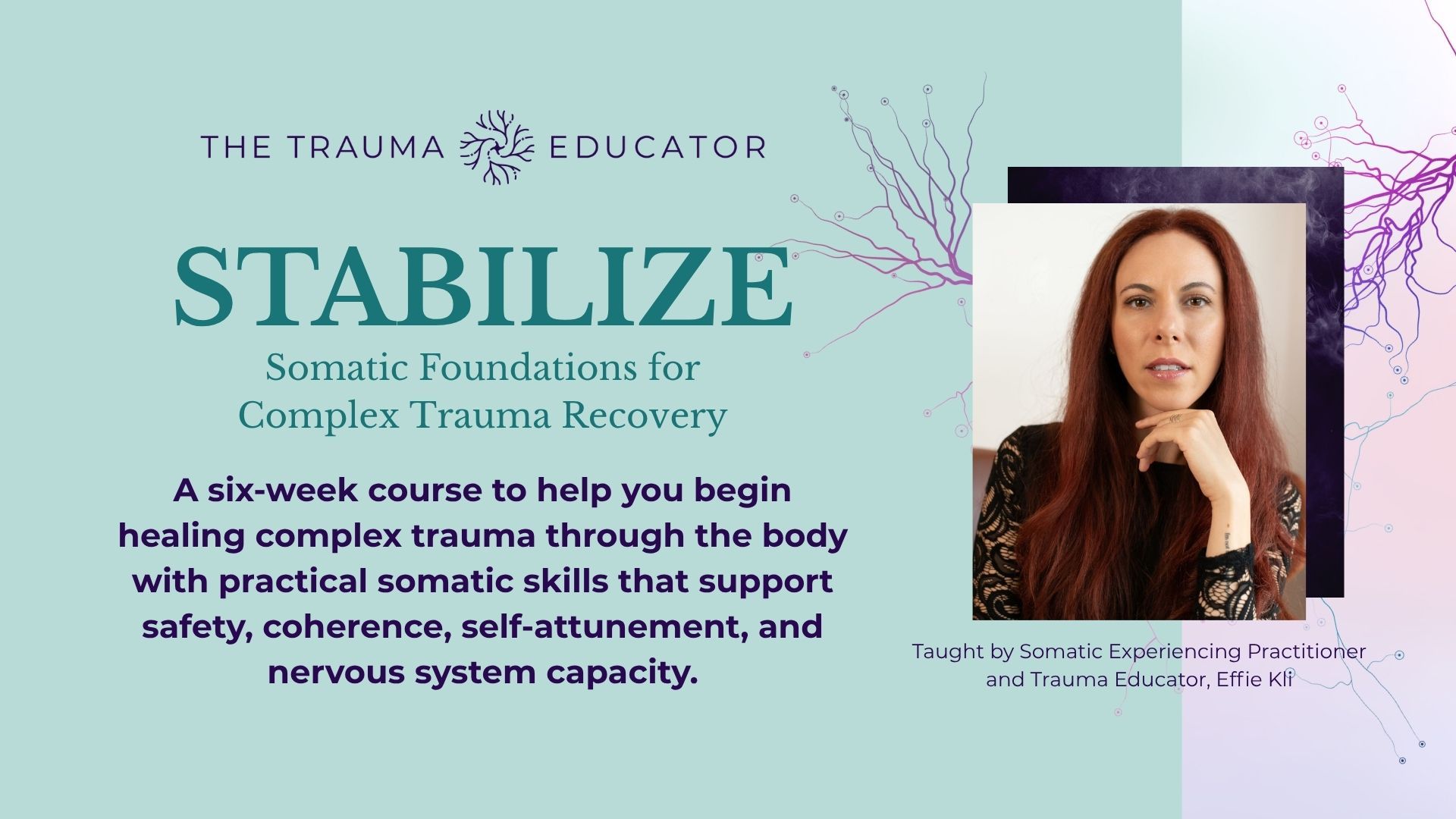
A Stabilized Nervous System is a Nervous System that Can Heal
STABILIZE will give you a practical, body-based foundation so your nervous system can start feeling safer in the present, instead of only understanding the past or waiting until you are “more healed” to begin living now.
Course begins July 15, 2026
If you live with complex trauma, understanding your past is not enough to feel safe in the present.
It's likely you know why you shut down, overthink, fawn, or go numb. You might understand your attachment patterns, your family system, and the ways your nervous system learned to survive.
And still, when something touches an old wound, your body responds before your mind has time to make sense of what is happening.
STABILIZE is for this exact place on your healing journey: when you don’t need more understanding about your past, but you desire practical, steady, repeatable somatic support so your nervous system can finally begin to feel safer.
Not more insight about the past or waiting until you are more healed to begin living. But a practical somatic foundation so your body can begin to feel safer, more present and more alive now.

Why stabilization matters after
complex trauma
After complex trauma, stabilization is the foundation that makes deeper somatic healing possible.
Yet, it's one of the most overlooked stages of trauma healing.
If your nervous system doesn’t yet have enough capacity to stay with sensation, emotion, or impulse, then deeper trauma work becomes overwhelming and pushes past your limits.
Stabilization becomes the foundation to build that necessary nervous system capacity.
- The capacity to notice your body before activation becomes overwhelming
- The capacity to stay with sensation without immediately fearing it, judging it, or trying to escape it
- The capacity to recognise a protective response without turning it into another personal failure
- The capacity to work with your body at a pace it can actually integrate
Stabilization is the internal foundation that allows you to go into deeper work without losing yourself.
STABILIZE is a six-week somatic course designed to help you begin building this foundational capacity slowly and practically.
STABILIZE is based on my RETURN™ Framework
RETURN™ maps six core markers of somatic healing after complex trauma.
Each marker represents a shift that begins to happen as the nervous system develops more capacity, and each marker has a catalyst: a quality that helps spark change in that area.
These markers show that healing trauma through the body is not one dramatic overnight transformation.
It is a series of subtle, meaningful shifts in how you notice yourself, relate to your inner experience, respond to activation, work with your body, practise processing and integration, and remain connected to yourself and others.
Over six weeks, we will explore each marker of the RETURN Framework to support the stabilization of your nervous system.
The Structure

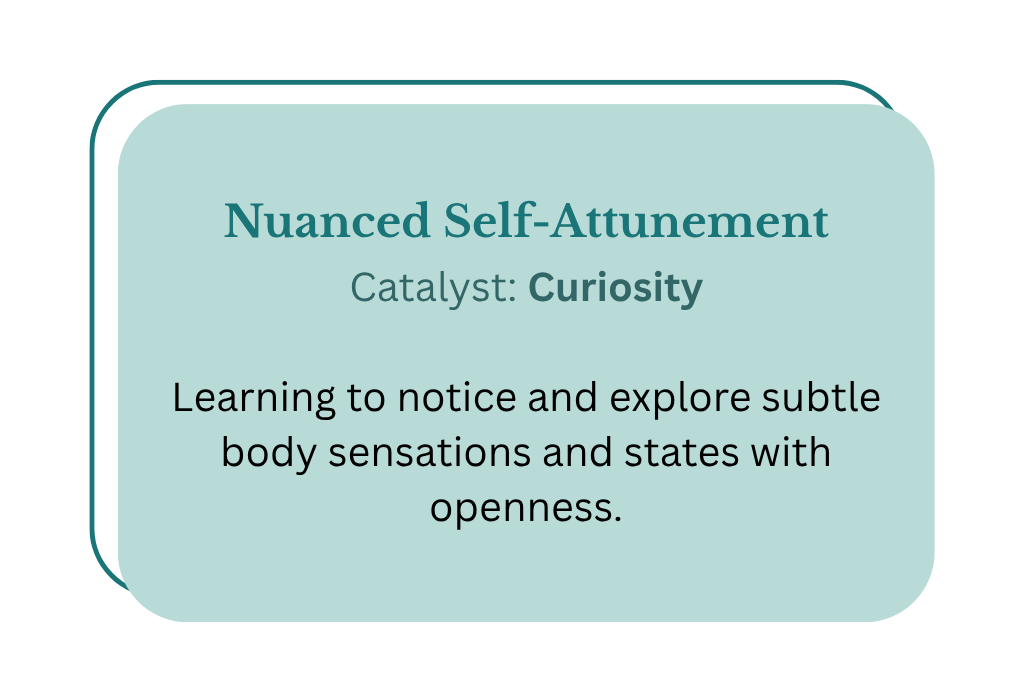
Nuanced Self-Attunement → Curiosity
After complex trauma, it can be difficult to know what is happening inside you.
You only notice your experience once it has become intense, and overwhelming. You might call everything “anxiety,” “shutdown,” “triggered,” or “too much,” without having the language or body-based awareness to notice the smaller shifts underneath.
Nuanced self-attunement is the capacity to begin noticing your body with more detail.
Noticing sensation, emotion, posture, breath, impulse, tension, collapse, numbness, aliveness, and the subtle changes in your nervous system before they become too big.
The catalyst is curiosity.
Not analysis. Not judgment. Not trying to fix yourself.
Curiosity allows you to begin asking: What is happening inside me right now? What is my body showing me? What am I noticing before I turn away from my experience?

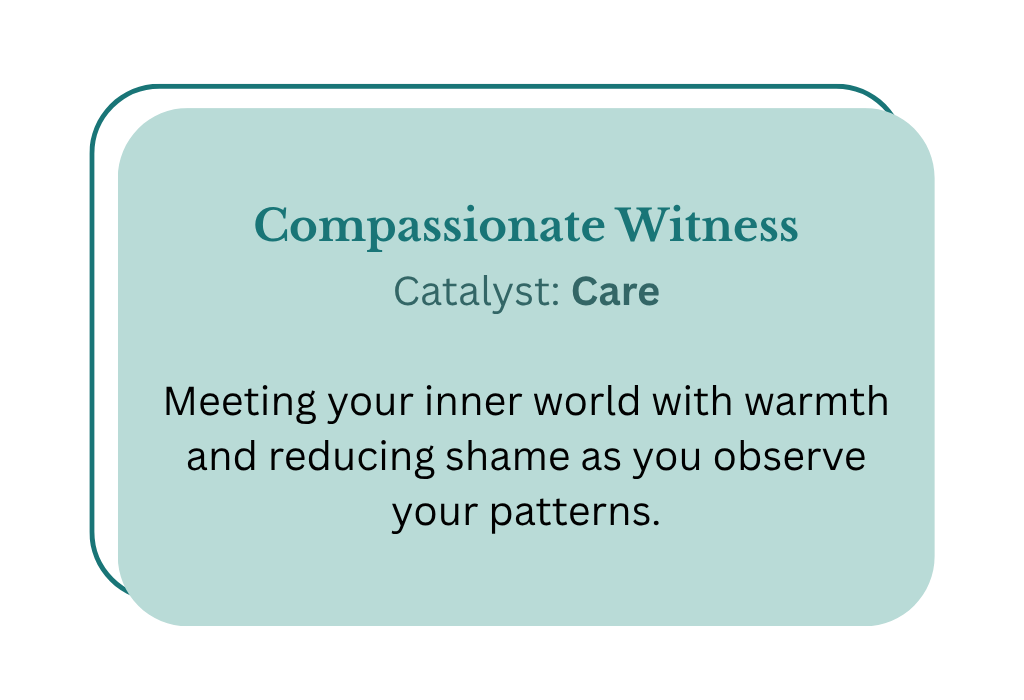
Compassionate Witness → Care
Many people with complex trauma do not only feel difficult emotions.
They feel shame about having difficult emotions.
They judge their needs, fear their reactions, criticize their sensitivity, and reject their inner world the moment it becomes inconvenient, confusing, or intense.
Compassionate witnessing is the capacity to observe what is happening inside you without immediately turning against yourself.
It does not mean pretending everything is fine.
It means learning to meet your patterns, sensations, protective responses, and emotional states with more warmth, care, and dignity.
The catalyst is care.
Because the nervous system does not soften through criticism.
It begins to soften when there is enough internal safety to be seen without being attacked.

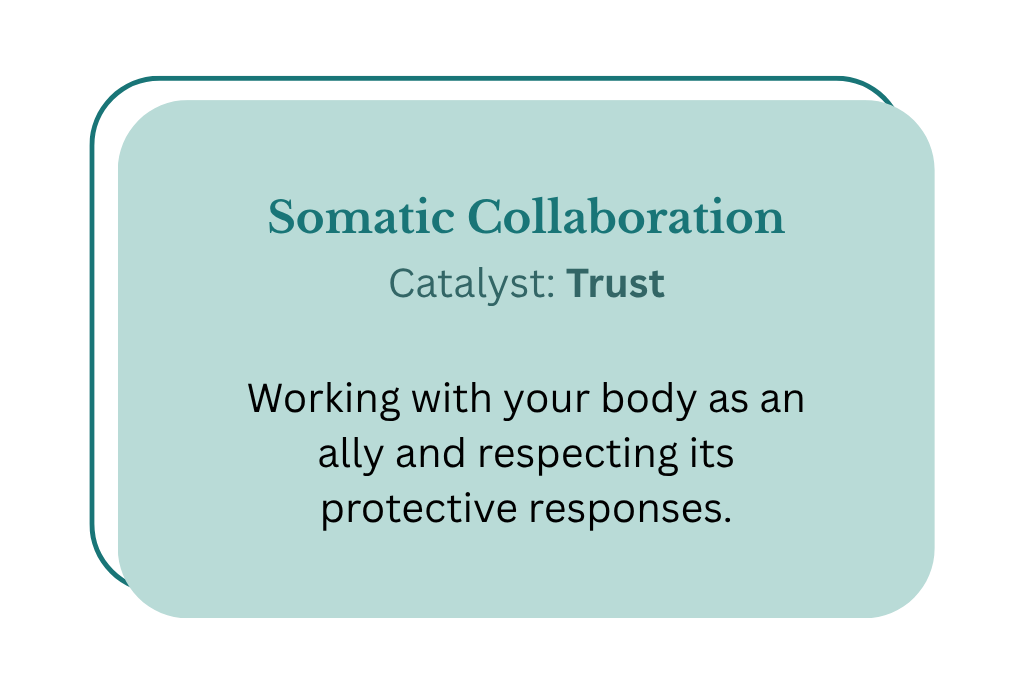
Somatic Collaboration → Trust
After complex trauma, you might relate to your body as if it is the problem.
You want to stop the anxiety, get rid of the shutdown, silence the fear, override the freeze, control the symptoms, or force the body to finally feel safe.
But the body is not trying to sabotage you. Its responses were once protective.
Somatic collaboration is the shift from fighting the body to working with it.
It means learning to respect the intelligence of protective responses, while also helping the nervous system discover new possibilities.
The catalyst is trust.
Not blind trust in every reaction as absolute truth, but a growing trust that your body is communicating something, protecting something, remembering something, or asking for support in the only language it currently has.

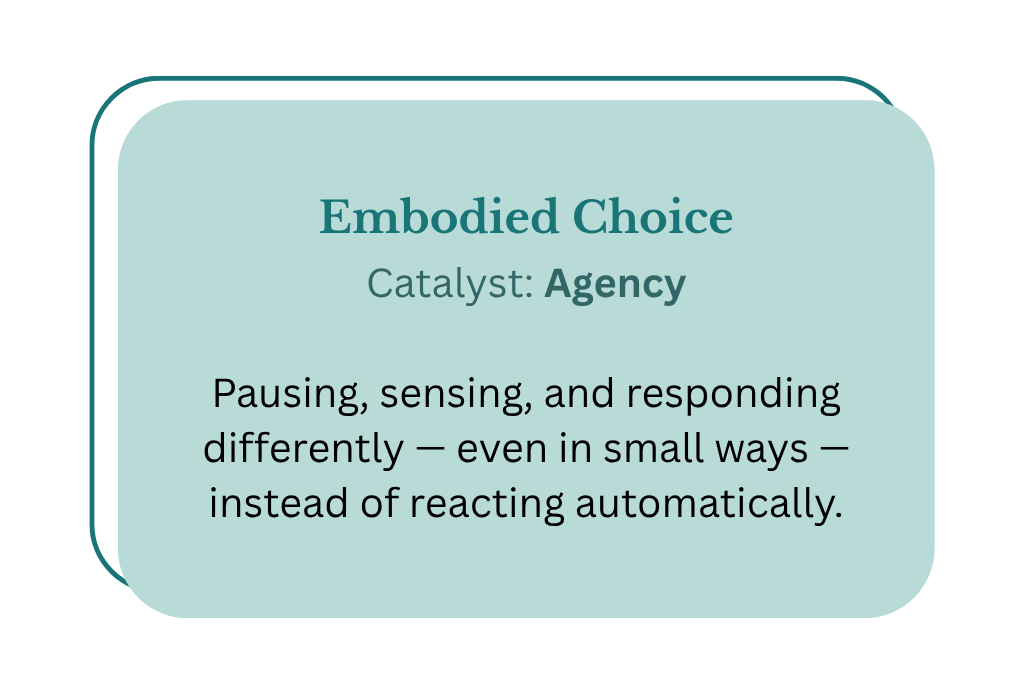
Embodied Choice → Agency
Complex trauma trains the body into automatic responses.
Your body fawns before you know what you want.
It freezes before you can speak.
It shuts down before you can ask for support.
You become defensive, compliant, or hypervigilant before you have any felt sense of choice.
Embodied choice is the capacity to pause, sense, and respond differently, even in small ways.
It is not about forcing yourself to become regulated or perfectly secure.
It is about slowly recovering the sense that you can participate in your own experience.
The catalyst is agency.
Agency begins in small moments: noticing a tiny impulse, choosing to slow down, placing a hand somewhere supportive, saying no, saying yes, taking space, orienting to the room, allowing a boundary, or responding to your body before the pattern completes itself automatically.

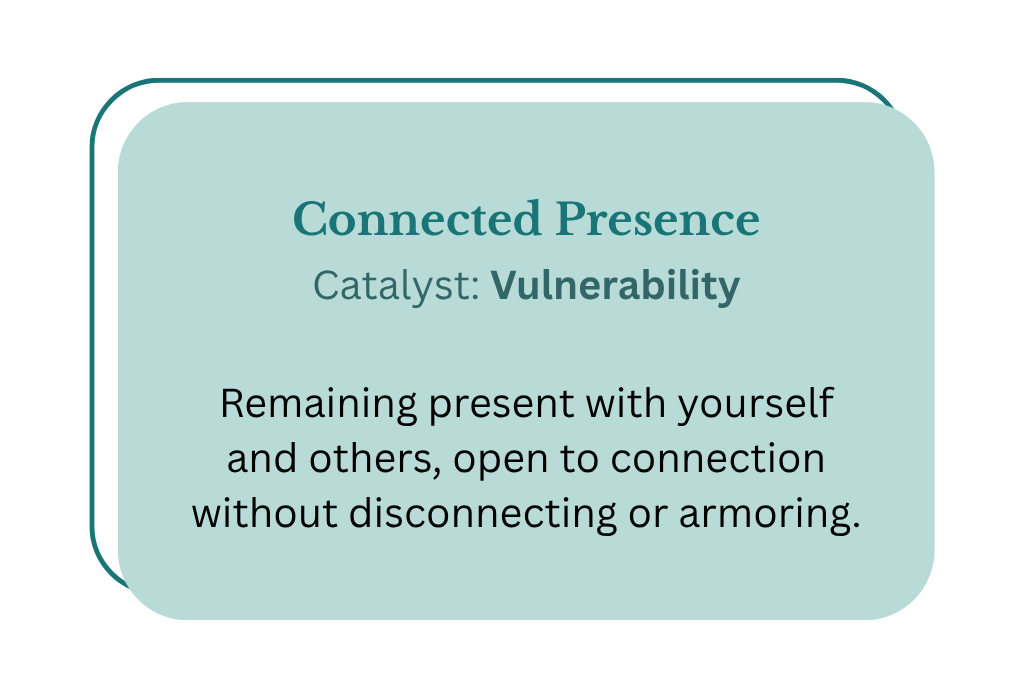
Connected Presence → Vulnerability
Complex trauma often makes connection complicated.
You may want closeness, but feel overwhelmed by it.
You may long to be seen, but armour when visibility arrives.
You may crave support, but disconnect when someone offers help.
You may stay physically present while emotionally leaving, or remain connected to others while abandoning your needs.
Connected presence is the capacity to remain with yourself while also staying open to contact with another person.
It is not about becoming endlessly available, exposed, or relationally perfect.
It is about increasing your capacity to stay present only a little bit more before collapsing, armouring, performing, pleasing, disappearing, or bracing for harm.
The catalyst is vulnerability.
Vulnerability is not forced openness.
It is the slow restoration of enough safety to be here, in your body, in contact, without losing yourself.

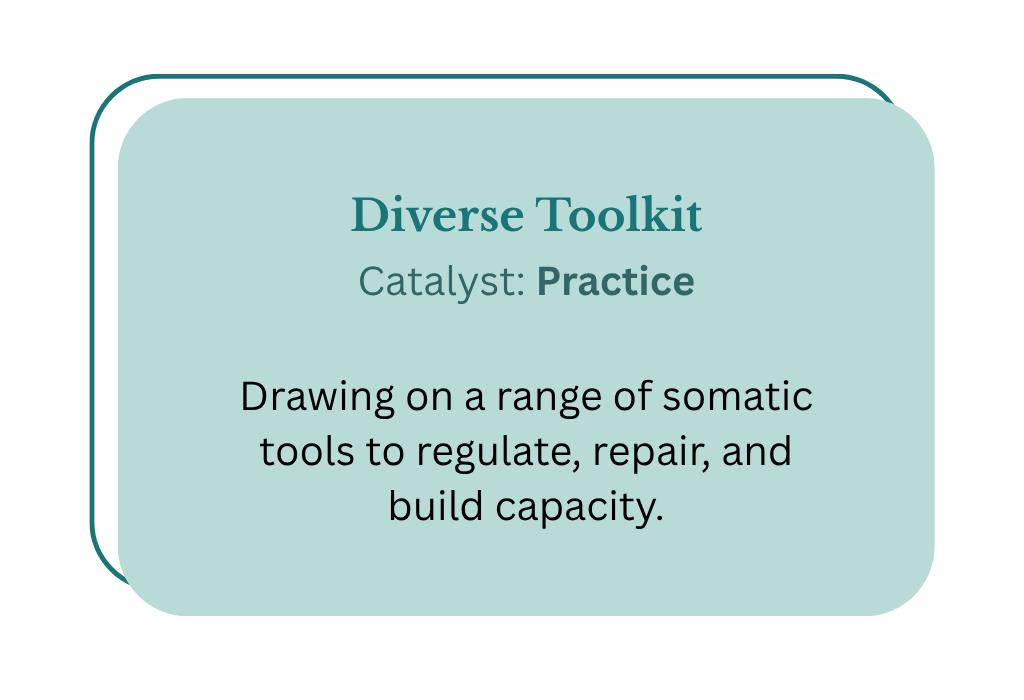
Diverse Toolkit → Practice
Somatic healing is not one tool, one technique, or one perfect method.
Complex trauma affects the nervous system, body, emotions, relationships, beliefs, impulses, identity, and sense of self.
Because of this, healing often requires a diverse toolkit.
You need practices that help you notice.
Practices that help you slow down.
Practices that help you orient.
Practices that help you feel.
Practices that help you come out of shutdown.
Practices that help you work with activation.
Practices that help you return to your body gently, without overwhelming it.
The catalyst is practice.
Practice is what allows new pathways to become more available over time.
In STABILIZE, you will not only learn ideas about somatic healing. You will begin building a practical foundation you can keep returning to.
This is for you if:
- You live with the impact of complex trauma and want to begin healing through the body in a way that feels practical, steady, and accessible.
- You understand your trauma intellectually, but still feel overwhelmed, disconnected, numb, reactive, or unsure how to support your nervous system daily.
- You often notice your patterns after they have already taken over, and you want to begin recognising the earlier signals in your body.
- You judge, shame, fear, analyze, or abandon your inner experience when difficult sensations or emotions arise.
- You want to develop more self-attunement, emotional capacity, and nervous system awareness without pushing yourself past your limits.
- You are curious about somatic work, but need a grounded foundation before entering deeper trauma processing.
- You want practical, simple tools that help you work with your body in your daily life, not override it.
- You want a trauma-informed space where healing is approached as gradual capacity-building rather than a quick fix.
- You want to begin feeling safer, more present, and more alive now, without waiting until every layer of trauma has been processed first.
This might not be suitable for you if:
- You are currently unsafe in your environment and need immediate crisis support.
- You are looking for personalised 1:1 therapy, diagnosis, or clinical treatment.
- You want a quick fix or a promise that your nervous system will change overnight.
- You are looking for intense cathartic trauma processing rather than slow foundational capacity-building.
- You do not want to engage with body-based practice, reflection, or gentle experimentation between sessions.
What's Included:

Six Live Classes with Replays
Each week, we will explore one marker of the RETURN Framework with its catalyst through accessible trauma and nervous system education, and guided somatic practices.
Dates:
Wednesday July 15: Nuanced Self-Attunement and Curiosity
Wednesday July 22: Compassionate Witness and Care
Wednesday July 29: Somatic Collaboration and Trust
Wednesday August 5: Embodied Choice and Agency
Wednesday August 12: Connected Presence and Vulnerability
Wednesday August 19: Diverse Toolkit and Practice
All classes will start at 5pm BST / 12pm EDT / 9am PDT, and will last for approximately 90 minutes.

Private Community
You will have access to a private community space where you can reflect, share, ask me questions, and stay connected to the course process.

1 Year of Access
You will have one year access to the replays, so you can revisit the teachings and practices at your own pace.

Six Somatic PDF Processes
Each week, you will receive a practical somatic PDF process connected to that week’s marker and catalyst.
These processes are designed to help you continue practising between sessions and bring the work into your daily life during and after the course ends.
About Me
Effie Kli is a trauma-trained somatic coach and educator with extensive training in somatics, the nervous system, and trauma, and over eight years of experience supporting clients privately and in groups. Her credentials include training as a Somatic Experiencing® Practitioner, Compassionate Inquiry (the somatic-based psychotherapeutic approach developed by Dr. Gabor Maté for healing trauma), the Polyvagal Certificate Course, and a High Performance Coaching Certificate — forming a rigorous, multi-disciplinary foundation for her work. Her holistic approach is informed by science-backed psychology and neuroscience, by the understanding that body and mind are one system, and by what she sees her clients benefit from as she supports them with the processing of trauma and repressed emotions stored in their bodies.
For two decades she lived with cPTSD, and one thing she's seen proven inside her practice and through her own personal change is that our body always guides us towards healing.
In her work and teachings, Effie is not interested in pathologising symptoms and pain because these are our body's way of talking to us. Instead of shaming those experiences, a paradigm shift of healing is to learn to apply compassionate curiosity and learn to speak our body's language so that trauma gets resolved sustainably.





"Effie's course has been life changing for me. I decided to join because of her philosophy, her story and because I felt that she'd 'get' me. She broke down complex information so it was understandable, gave me tools to support myself with my cPTSD, anxiety and depression, and she offered persistent and reliable guidance. There has been such a transformation for me and I'm in a totally difference place compared to where I was before."
Corina Ebnother
"Effie showed me how to re-connect with my body, to feel my feelings, and how to listen to them. She challenged me to see the past and myself without the shame, and soon it became clear to me that there wasn’t anything wrong with me’. She helped me get to the core of my problem, gave me tools to transcend it, and techniques to help me feel and release emotions I used to shut down out of fear. She truly helped me feel ‘whole’ again."
Dave Cooke
Your Investment
STABILIZE: Somatic Foundations for Complex Trauma Recovery
Course Begins: July 15, 2026
Six live calls
Six somatic PDF processes
Private community
One year access
One payment of only £299
"Your guidance has helped me immensely. I feel my emotional, mental and physical situation has improved a lot, and it happened in the best moment in my life. In certain ways my whole mindset shifted and I learnt a new approach. It works! I will use the methods you taught us. Thank you for being a devoted, genuine, motivating, sensitive and warm-hearted human being."
Szilvia Frank
"I feel that the biggest part of not feeling worthy and feeling inadequate has been healed through working with Effie."
Lili Suke
"Effie’s ability to get to the truth of the matter and create a path to a different way of seeing myself has been life changing."
Susannah Barrie
Your Questions Answered
What happens after I sign up?
What if I can't attend live?
Do I need previous experience with somatic work?
Is this therapy?
Will this help me process trauma memories?
What is the refund policy?
Begin with stabilization
You don't need to force your nervous system into healing.
You don't need to push your body to soften before it feels ready.
After complex trauma, somatic healing begins more subtly. It begins with a little more noticing, a little more curiosity, a little more compassion. With one small moment of choice.
With learning to work with your body instead of against it.
With building enough capacity to stay with yourself a little more than before.
STABILIZE is an invitation to begin here: to build a practical, gentle somatic foundation so your body can finally start to feel safer.
If that feels like the next right step, I’d love to walk it with you.